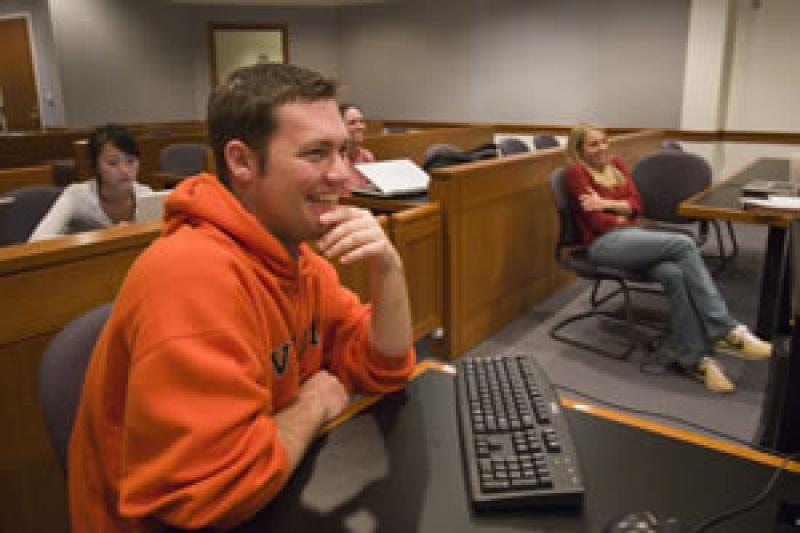
Virginia�s Collegiate Mock Trial team is the national champion. Members do their homework, learn to think on their feet and have lots of fun.
October 25, 2006 - Who could imagine prosecuting Tinker Bell for trafficking in illegal fairy dust? Or prosecuting Santa Claus for flying unauthorized aircraft without a license? A sharp-witted member of the country�s current top Collegiate Mock Trial team, that�s who.
This small group of would-be trial lawyers may look ever so serious in their extracurricular uniforms of pressed suits and shiny dress shoes, but the members of U.Va.�s mock trial team are all smart enough to know that laughter and likeability are hallmarks of success, too. Their web page sports the details of last year�s winning season via a series of snappy video clips set to music with trailers that mock �Law and Order� and big-screen movies.
Last year�s successes, including their national championship triumph over Harvard in a 64-team contest last April, also set the stage for another round of tough tryouts this fall for other undergraduates wanting a role in the activity sometimes described as �theatrical litigation.�
Program president and webmaster Daniel Young (Government and Foreign Affairs, History �07) calculates that some 250 students signed up for more information at an activities fair, with 59 showing up to participate in the two-stage selection process. �It�s very competitive,� Young acknowledges, explaining how students must deliver a short speech prosecuting or defending a fictional character. Cary Mayberger (College �09), for example, auditioned last fall with the argument that the Prince was guilty of unlawful conduct for approaching Sleeping Beauty without consent.
Candidates judged successful are invited back for a second interview, not only for a probe of their academic prowess but also for a search for the sense of humor that makes for good rapport during intense late-night practices and out-of-state travel competitions. Jamar Walker (Political Philosophy �08), a member of last year�s championship team, both grinned and groaned when he recalled the two 12-hour days he logged as an interviewer during this year�s auditions.
The group � 17 strong this year, featuring men and women from all four class years � began the season with twice-a-week, three-hour practice sessions in an empty law school classroom. Early practices look suspiciously like more coursework: laptops, PowerPoint presentations, lectures on effective opening and closing arguments. But cameo appearances by Denny Crane, Fla-Vor-Ice popsicles, quizzes a la �Family Feud� and a constant barrage of wisecracks keep the mood light and the laughs coming.
By the time the students reach their three-hour, out-of-town competitions, where groups of six repeatedly switch roles as plaintiff, witness, defense attorney or prosecutor during multiple rounds of argument, they will be thinking as a team and supporting each other with whispered suggestions about how to exploit an opposing team�s legal missteps.
Because some aspects of the trials are practically scripted in advance, former team member and assistant coach Samantha Bateman (Political Philosophy, English �06) counsels the newcomers that �a very good mock trial calls for execution of a good game plan, but a great mock trial happens when you can manage an improv, or riff from your game plan. And do it well. That gets points,� she emphasizes. Mock trial rewards �thinking on your feet,� adds Young.
Shikha Gupta (College �10) had competed in forensics at her Virginia Beach high school and was eager to join the U.Va. team. But it�s hardly her only extracurricular. On top of 17 credit hours, she�s volunteering for Madison House, serving as a representative to the First Year Council and considering a future run for Student Council.
�A high percentage of mock trial participants do go on to law school,� notes Young, �but by no means is that true for everyone.�
The American Mock Trial Association (AMTA) presents the particulars of a single case to over 600 some collegiate teams each August. This year students will prosecute and defend a civil matter; last year�s teams argued a criminal case. The 2006-07 season began Oct. 20 for U.Va. with a competition at the University of Richmond, followed by one hosted by the Virginia team in Washington D.C. on Nov. 4, where real-life attorneys and courtroom judges, some of them U.Va. alumni, will preside as competition judges.
=======================================
Article by By Jeanne Nicholson Siler (MA, Anthropology '03) and reprinted with permission from Arts and Sciences Magazine Online.smrtovnice